
At Panda Express, a mom and pop empire
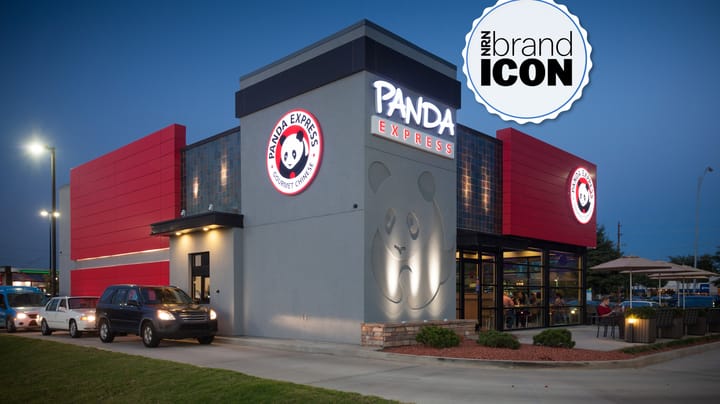
Nation’s Restaurant News’ annual Brand Icon award honors major restaurant companies that live at the intersection of legacy and innovation, recognizing their past while also maintaining relevance among modern-day consumers.
Still led by Cofounders Andrew and Peggy Cherng, this year’s Brand Icon winner has spent more than 50 years living at the intersection of cultural origin and original expression.
July 9, 2026
The first thing one sees upon entering the parking lot at Panda Restaurant Group’s Rosemead, California, headquarters is not a panda or a restaurant or any other indicator that it’s the Support Center for the 11th largest foodservice chain in the U.S.
No, the first thing one sees is the iconic, bright-red LOVE sculpture from pop artist Robert Indiana, 12 feet tall and with the “O” at an angle atop the “E,” on an island in the middle of a long driveway.
It may not be the obvious choice for a restaurant company that has helped define Chinese flavors for millions of Americans. But it suits a business that is still quintessentially “mom and pop” even as Panda Express boasts more than 2,600 locations in the U.S. pulling in more than $6 billion in revenue.
In his spacious office marked by tokens of a career now extending over half a century, the “pop” in this equation, Cofounder and Co-CEO Andrew Cherng, reflects on the legacy that he and his wife, cofounder, and co-CEO, Dr. Peggy Cherng, have built at Panda. There’s the cultural impact Panda Express has made by becoming the first Asian restaurant chain to achieve a national footprint. But more important, Andrew Cherng said, is the impact that the company has made on people — employees and customers alike — by pushing them to chase a better version of themselves.
“We can show our love, we can show our care in many ways and go out of our way to take care of people,” he said. “We’re really delivering love and care into the world.”
A bright future
While Panda Express’s origins date to 1983, the story of the brand reaches back to the late 1960s, when Andrew and Peggy Cherng first met as immigrants at Baker University in Kansas, and then to 1973, the year Andrew Cherng opened Panda Inn with his father, Chef Ming-Tsai Cherng, in Pasadena, California.
As manager of that upscale, full-service restaurant, it was the first time Andrew Cherng was in charge of a business, and he saw a “bright future” in the authentic Mandarin flavors that he and his father, a recognized chef in the area, could bring to the community — until the doors opened and that hope quickly dissipated.
“The going in the beginning was very difficult — very hard to overcome. The building of the business at that time took a lot longer, [was] a lot more difficult than I ever imagined,” he said. “That was probably a good blessing in disguise. It made me more hungry. How do [I] show guests I really care about [them]? … It was a very trying time, but the idea of the importance of the guest, it just got elevated.”
Business eventually picked up, which Andrew Cherng attributes to a revised lunch menu that featured not standard American-Chinese fare like chop suey and chow mein, but rather authentic dishes from the dinner menu at smaller portions and prices.
Five years later, Andrew Cherng and business partner Mark Ting opened the restaurant Plum Tree Inn in Los Angeles’s Chinatown, and a few years after that another Panda Inn opened in nearby Glendale. Those openings, combined with extensive remodels required at the original Panda Inn to expand and keep up with growing demand, helped Cherng better understand how to design the Panda experience — which came in handy in 1983, when the opportunity arose to open a quick-service version of Panda in the Glendale Galleria Mall.
“It was a smaller Panda Inn menu [at] Panda Express,” he said. “We felt like some of the dishes [could be] duplicated and [served] quickly. We tried a lot of food that we served. Some of them worked out really well, and some of them did not.” Business, he said, “came easily.”
With that first Panda Express, the Cherngs — Peggy being fully involved in the business by this point, using her engineering background to build operational systems for the burgeoning company — also introduced profit sharing for store chefs and general managers. And as they opened new locations, they tapped into existing employees to lead those new stores.
“I think the special [nature of the business] is actually the value of people,” Peggy Cherng said. “In the initial stages of Panda Express, we actually promoted [from] within, one for the kitchen and then one for the front [of house]. We allowed them to shine through, and then afterward they always promoted a pair to every new store that was opened. So it’s really transforming the restaurant business to become also a people-demand business.”
It was around then that a community of “aunties and uncles” filled out the Panda team and helped to drive fast growth, said Andrea Cherng, Andrew and Peggy’s daughter and chief brand officer for Panda Express.
“From a very young age, I knew that the aunties and uncles were important. And this group of aunties and uncles actually very much were what we call the ‘Panda Pioneers,’” Andrea Cherng said. “They were the group of people that worked alongside my parents to move the restaurant from one restaurant to 10 restaurants to 20 restaurants to 100 restaurants. And so I think what was always very clear to me was that there was a dynamic of almost like a second family that was happening, that was allowing us to grow.”
By 1993, Panda Express had grown to 100 mall-based locations. The first free standing location, which also had the brand’s first drive-thru, opened in 1997, and by 2007, Panda Express had reached 1,000 units (only a small percentage of locations today are based in malls). In 2011, the brand opened its first international location in Mexico City, and six years later opened its 2,000th unit in New York City.
At the close of 2025, Panda Express had 2,609 locations in the U.S., according to the Technomic Top 500, and $6.7 billion in systemwide sales — a figure that grew 9% last year and put it about $2 billion shy of being a top 10 chain.
Even more impressive is the degree to which Panda Express dominates the Asian chain category; the brand’s annual sales are nearly eight times those of the next biggest competitor in the category, P.F. Chang’s, and more than 21 times those of the next closest Asian QSR, Sarku Japan, according to Technomic.
In a parallel universe, maybe Panda Express never reaches that mainstream success. Maybe it falters with the fizzling of mall culture. But in this universe, Panda Express picked up a tailwind in 1987 that changed everything.
Origin plus original expression
Fans of Chinese food in the U.S. take for granted that Orange Chicken is a relative newcomer to the culinary stage.
Today, it is the No. 1 Chinese chicken dish served in U.S. restaurants, according to Technomic Ignite data, far outpacing dishes like General Tso, Kung Pao, and Sweet-and-Sour Chicken. But Orange Chicken didn’t exist until 1987, when Panda Express’s executive chef at the time, Andy Kao, developed the dish as a special at a location in Hawaii.
“Orange Chicken is really about delivering the experience that people want … because we had the right flavor with the right people, and they cannot get enough of it,” Andrew Cherng said. “That’s success. … I’m glad that our name is sort of synonymous with Orange Chicken.”
Orange Chicken is by far Panda Express’s No. 1 seller, with a third of all orders including it; the brand sold 148 million pounds of Orange Chicken last year. But the company hasn’t stopped pressing on the accelerator with menu innovation, with a regular rotation of LTOs that stretch the possibilities of Chinese flavors.
Panda Express’s approach to menu innovation is a lesson in balance, specifically between two cultural influences. Company leaders are careful to stress that the menu is not necessarily authentically Chinese, but rather American-Chinese. As Andrea Cherng said, it’s about “honoring origin while aiming for originality.”
“We get to be witty and playful,” said Jimmy Wang, executive director of product innovation at Panda Restaurant Group. “We get to combine two different cultures together, and we spend time here in this test kitchen putting ideas together that may be conceptual and close to someone’s culture. But it’s also familiar enough for some that have never seen it before.”
A recent example includes this summer’s Cantonese BBQ Brisket LTO, which tosses hand-cut brisket with a smokey, Chinese-inspired barbecue sauce — not authentically Chinese or American by any stretch of the imagination, but a delicious pairing of the two cultures.
Andrea Cherng notes that there are eight regional Chinese cuisines — Sichuan, Cantonese, Shandong, Jiangsu, Zhejiang, Hunan, Fujian, and Anhui — and that Panda Express aspires to make American-Chinese a ninth distinct sub-category.
“People of all backgrounds want to dig into origin, understand heritage, and understand what it means to honor that,” she said. “But they also understand the desire for original expression. So leaning into those core values that are resonant with all audiences, but then … bringing unapologetically the traditions, the customs, the color of our background, and an unapologetic American-Chinese identity, is, I think, part of the incredibly fun job that we get to do.”
While Panda Express established an Innovation Kitchen in 2014 to push the boundaries on what American-Chinese food could taste like, it’s also doubled down on technology innovation that improves the broader customer and employee experience.
In 2020, Panda Express embraced automation with the roll out of its Panda Auto Wok, which was designed to make the labor-intensive wok process easier and faster for employees. And in 2023, the chain launched its first loyalty program, Panda Rewards, which surpassed 5 million users within a year and today has more than 20 million users.
Panda Rewards features a standard points-based system for users, but also engaging features like Wok Wednesday, through which customers can play games to earn prizes — something Andrea Cherng calls “experiential innovation.”
Recent innovation, she noted, has centered around the Panda Express story and finding the same kind of original expression in its messaging as it presents on its menu. With the emergence of the creator economy, she said, Panda has “completely reevaluated” its playbook in building relationships with guests, which this year included the animated short “Wishes” in celebration of the Lunar New Year.
Going forward, Panda expects to pay more attention to the back of house and ways technology can improve employee experience.
“If we can have more predictive sales volumes, if we can know per store the amount of volume that’s incoming in each of the channels at each of the dayparts — and actually be able to set up our operators to be able to respond to that volume — that will enable them to deliver a better guest experience,” Andrea Cherng said.
Immigrant ethos
Eagle-eyed observers have noted that the name “Panda” can be interpreted as “P and A,” — Peggy and Andrew. While purely coincidence, it does feel like an appropriate hat tip to the significance that the Cherngs play in the success of Panda Express: Andrew, who self-identifies as “forward looking … a sort of pioneer, trailblazer,” and Peggy, who essentially built Panda’s first POS system and continues to power the innovative systems driving the company. Panda’s own press materials note that Andrew and Peggy Cherng operate as a yin and yang, boasting complementary strengths of “visionary entrepreneurship and people-centered engineering.”
Their steadfast leadership over a half-century in business is rare for any company, let alone one in the volatile restaurant industry. And it’s a big reason, Andrea Cherng said, why Panda Express has become so dominant.
“I think what’s made us successful is that, fundamentally, we started as a mom and pop Chinese restaurant, and today we are still a mom and pop Chinese restaurant. There is a mom who’s leading the way. There is a pop that’s leading the way,” she said. “But what that symbolizes for us is that there is a consistency in leadership and a consistency in values and a consistency in mission. … And it’s also because these people, the mom and pop, are unafraid of reinvention. They’re always moving the quotient to how we get better.”
Andrew Cherng likes to repeat one of the tenets of Panda’s core values — “no best, only better” — as reference to the ongoing work that Panda Restaurant Group directs toward improvement. For the Cherngs, “better” doesn’t necessarily mean better sales or better operations. Rather, it goes back to the LOVE statue in the parking lot: “Better” means continuous improvement in people, both professionally and personally.
“I think the most valuable part of Panda is that we’re about building a better life for ourselves and others,” Andrew Cherng said.
The company has gone to great lengths to invest in its 55,000-plus employees (“associates” in Panda lingo), which includes the profit-sharing program as well as a partnership with the University of Nevada, Las Vegas (UNLV) called the University of Panda. Through this program, founded in 2013, associates can take classes and get college credit.
That work has helped Panda land on lists like Fortune’s 100 Best Companies to Work For and People’s Companies that Care.
“The only thing that you can do is to elevate everyone’s caring ability. Why would they care about their job? Because our leaders care about their people,” Andrew Cherng said.
From a humble Chinese restaurant in Pasadena to an international success worth nearly $7 billion, Panda Restaurant Group and its flagship Panda Express brand have demonstrated that through hard work and care toward others, anyone can achieve iconic status.
“That mission of inspiring better lives, this is from an immigrant ethos,” Andrea Cherng said. “This is from the fact that my parents came here with an aspiration for a better life, and they were able to build a better life here. And so if they can build an organization where people can actually have better lives, and they can move the minds and hearts of people to actually aspire to that, that is sort of the DNA of the organization.”
Contact Sam at [email protected]
About the Author
Sam Oches
Editor in Chief
Sam Oches is an award-winning Editorial Director with Informa Connect Foodservice and editor in chief of Nation's Restaurant News and Restaurant Hospitality. A graduate of the E.W. Scripps School of Journalism at Ohio University in Athens, Ohio, Sam previously served as Editorial Director of Food News Media, publisher of QSR and FSR magazines. He’s a past president of the International Foodservice Editorial Council (IFEC) and a past board member with the American Society of Business Publication Editors (ASBPE). His foodservice insights have been shared in national media outlets such as the New York Times, USA Today, National Public Radio, and CNBC. He lives in Columbus, Ohio, with his wife and three kids.
Content Spotlight
The Technomic Top 500: Another tough year for chain restaurants
Top 500 chain restaurant sales slowed again in 2025 as consumers cut back on dining, but sectors like coffee, beverages and snacks and chicken thrived
Featured
Jul 8, 2026
Jul 2, 2026
Recent News
Content Spotlight
Get to know Rick Cardenas, the Darden CEO who started there as a busser
The executive shares his advice, along with his most-binged TV show, favorite sports team, and most-used app
Source: This story originated with Nation's Restaurant News.
View Original Article →