

Ggiata brings the heart of New Jersey deli culture to L.A.
Awarded annually, Hot Concepts recognize emerging chains from around the U.S. that have impressive growth momentum and the potential to become household names.
This 7-unit fast-casual sandwich concept is growing slowly, creating one neighborhood hub at a time.
July 14, 2026
When best friends Jack Biebel, Noah Holton-Raphael, and Max Bahramipour were growing up in Montclair, N.J., delis were where life happened.
Sure, there was terrific food. But the East Coast delis they loved were also the heart of the neighborhood. They were the place that framed the Little League photo when the neighborhood team won a championship, or the place where a sandwich was named for a local student who graduated. It was where they hung out.
When the three friends came to Los Angeles in 2018, they went looking for that kind of East Coast deli they grew up with. But, at the time, it didn’t really exist in the sprawling, traffic-clogged West Coast city.
So they created it. And that’s how the now-seven-unit Ggiata Delicatessen was born.
Given their near-complete lack of restaurant experience prior to the launch, it’s a story with an improbable beginning. But Ggiata is now one of the hottest fast-casual brands in Los Angeles and helped usher in a wave of sandwich-concept innovation across the city.
Ggiata is known for massive hot and cold Italian sandwiches, priced at roughly $16-$18. There’s the Spicy P, with a chicken cutlet, spicy vodka sauce, mozzarella, and pesto on a seeded baguette, and the Prosciutto Panini stuffed with prosciutto, Genoa salami, stracciatella, basil, arugula, honey, Calabrian chiles, tomato, and pesto aioli on grilled ciabatta. A breakout star has been the Crispy Chicken Caesar Wrap, which is like a Caesar salad with a crispy chicken cutlet wrapped in a flour tortilla.
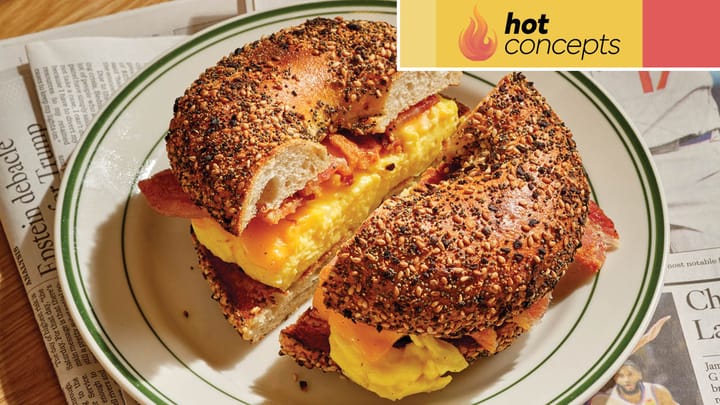
There are breakfast sandwiches and a buttermilk biscuit with somewhat of a cult following. The menu is rounded with hearty salads, sides like arancini or meatballs, and a few desserts, like the limoncello olive oil cake and the colorful layered Rainbow Cookies.
The average check is about $30.
But, even more importantly to the founders, Ggiata is positioning to be that great neighborhood deli that is fully engaged in the communities in which it opens, said Biebel. And that’s not easy to replicate as a brand grows.
Ggiata is growing at a rate of about one to two a year. Number eight will open later in 2026 and will be the first outside Los Angeles — though the co-founders are not ready to say where it will be.
All units are company owned and there are no plans to franchise.
“We want to control every aspect, end to end,” Biebel said. “From the way the menuboards look … to the way the team speaks to every single customer that walks in, that needs to be from the three of us and our leadership team.”
It’s that shared vision that makes it work, the cofounders said.
Biebel and Holton-Raphael have known each other since they were 9 years old. Bahramipour entered the friendship in sixth grade.
The three went their separate ways for college. They later came to L.A. to visit another friend, and they were hooked. They found jobs in the city and moved into a big house.
“Back home, they thought we were like [the characters in the show] ‘Entourage,’” said Biebel, referring to the HBO show starring Mark Wahlberg and his entourage. “We definitely weren’t.”
They combed L.A. for delis, like the ones they grew up with. They found good Jewish delis, and other great sandwiches — like at Gjusta, a bakery-café founded by Gjelina chef Travis Lett (who, Biebel notes, is also from New Jersey).
Almost as a lark, the three began to brainstorm a deli that satisfied that itch. The name, for example, is a shortened version of the term “La Passeggiata,” which in Italian refers to the tradition of going for an evening stroll and chatting with neighbors.
The main obstacle: None of them had worked in food, other than the odd summer job bussing tables when they were younger.
At the time, Holton-Raphael was desperate to leave his corporate job. One day, he threatened to quit and go work at Gjusta. Biebel and Bahramipour begged him not to.
The next day, he did.
Holton-Raphael said he worked at Gjusta less than a year, but he learned about the industry. And he met a chef there who was willing to help develop a menu for the concept the three friends were, at that point, taking a bit more seriously.
They decided to start with a food truck. The three put a deposit down on a truck in February 2020.
Just a few weeks later, COVID-19 hit.
Happily, they were able to get their deposit back. (“Noah can fake cry,” Biebel said.)
Quickly, they pivoted to delivery only, working out of a CloudKitchen location. But then the week they opened there, the George Floyd riots erupted, shutting down the CloudKitchen operation for three days.
Despite the setbacks, Ggiata eventually took off.
Ggiata doesn’t operate out of ghost kitchens anymore. But it was beneficial, said Biebel, who called the experience “delivery bootcamp” that helped them build the brand’s digital presence and navigate third-party delivery.
The first brick-and-mortar Ggiata opened in 2021, a tiny 750-square-foot spot. It was a hit, and the brand began to grow. With each restaurant, the cofounders looked for locations at the heart of a neighborhood. With each opening, the square-footage grew a bit bigger.
The latest restaurant to open in the Echo Park neighborhood of L.A. earlier this year is about 1,600 square feet, for example, with 40 seats. Each location is unique, but with a nostalgic feel — and lots of references to “The Sopranos,” to which the brand pays homage.
Bahramipour leads the restaurant design and it’s a family affair. His mother (“chief mosaic officer”) laid the floor tiles, for example, and he has assembled a team of “crazy creatives” for elements like the bespoke painted lamps, and the hand-painted retro (decidedly not digital) menuboards.
Holton-Raphael handles the culinary side, business development, and marketing.
Biebel handles finance, technology, and business strategy. “Actually, Jack’s job is to show up for the interviews to look handsome,” Bahramipour said.
“Jack tries to help us keep the money we actually make,” added Holton-Raphael. “Max and I do our best to spend it all.”
Ggiata does not share sales numbers. The cofounders say they are not looking for “monster investors” or rushing to be on every corner.
“We’re growing this for the long run,” Holton-Raphael said. “So one day little Jack, little Max, and little Noah [junior] can roll up their sleeves and get their hands dirty.”
“We would rather have one store with an X average unit volume than four stores with .25,” Biebel said. “If we can make every store as special as possible in the perfect community, with the perfect location, we’ll play this game with AUV all day long.
“There are immeasurables that make Ggiata really special that you can’t put into a spreadsheet,” he added. “The three of us know that. No one needs to remind us how important those things are.”
About the Author
Lisa Jennings
Executive Editor, Restaurant Business
Lisa Jennings is a veteran restaurant industry reporter and editor who covers the fast-casual sector, independent restaurants and emerging chain concepts. Her experience includes other industry publications as well as the daily newspaper The Commercial Appeal in Memphis, Tenn., where she was Food Editor. Her work has been cited in the Los Angeles Times, Business Insider, FoodBeast, The Huffington Post, Time.com and more.
Content Spotlight
The Technomic Top 500: Another tough year for chain restaurants
Top 500 chain restaurant sales slowed again in 2025 as consumers cut back on dining, but sectors like coffee, beverages and snacks and chicken thrived
Featured
Jul 8, 2026
Jul 2, 2026
Recent News
Content Spotlight
Get to know Rick Cardenas, the Darden CEO who started there as a busser
The executive shares his advice, along with his most-binged TV show, favorite sports team, and most-used app
Source: This story originated with Nation's Restaurant News.
View Original Article →