

How Ryan Ratino manages beef prices at his new steakhouse
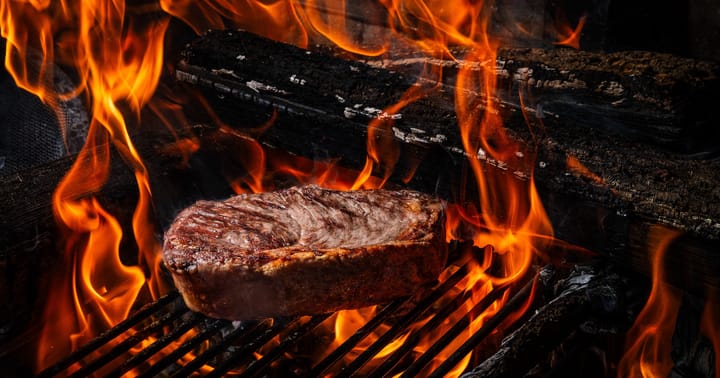
At Ox & Olive the D.C.-based chef finds value on multiple levels by working with small producers.
July 8, 2026
Ryan Ratino recently opened a steakhouse, but he doesn’t have a problem with beef prices.
Although commodity beef is currently at record highs, and expected to rise further, the chef and owner of the new Ox & Olive steakhouse, which opened in Washington, D.C.’s Georgetown neighborhood in May, isn’t feeling it.
“The commodity supply chain is what’s being impacted significantly,” said the chef.
Ratino also operates Bresca, a fine-dining restaurant in D.C.’s Logan Circle that opened in 2017, and its even more upscale tasting-menu counterpart, Jônt, that opened upstairs in 2020.
“Your small farmers who kill, like, four cows a week, maybe they raise the price a dollar a pound one week because gas is $5 a gallon, but we’re talking a buck, and then literally when the gas prices go down, they’re like, ‘Hey, we’re going to take that dollar back off.’”
He said that comes from having developed relationships with small producers over the past decade, which is paying off at his new restaurant, where Ratino is working with 16-18 different beef suppliers, both locally in the mid-Atlantic region and from around the world.
“People aren't willing to put in the time and energy for those relationships, though, because clearly it's harder to find a dozen of those producers than it is to go to one supplier and be like, ‘Hey, I need 180 striploins a week pre-cut, 175 rib eyes a week pre-cut.’ And then, yeah, you pay. But a little bit more effort can save you a lot,” he said.
He buys primal cuts and he and his team butcher them in-house, which adds to his labor cost, but that’s offset by the fact that, as with most other steakhouses, cooking the beef is straightforward and it’s served without the detailed garnishes that are on display at Bresca and Jônt, so he said labor cost is about the same.
And given how high mainstream beef prices are now, and thanks to Ratino’s relationships with niche producers, he’s actually getting good deals.
“My favorite beef on the whole menu is, like, 30% cheaper than prime beef from a large distributor. It is amazing, I love it, it marbles out better than any prime beef out there and it’s raised for a full 30 months, versus 18 months for prime beef,” he said. “I pay literally $8 a pound less than for a prime cow.”
And the menu prices reflect that.
On Ox & Olive’s current menu is a 9-ounce wagyu flank steak for $44, a 12-ounce striploin for $54, an 8-ounce tenderloin for $54, and a 10-ounce short rib for $49.
The restaurant also offers a rotating assortment of large-format steaks by the pound, currently ranging from $74 per pound from Bear Creek Farm in Tennessee to $115 for South Korean Hanwoo beef.
By comparison, a prime 8-ounce filet mignon at Del Frisco’s Double Eagle Steakhouse in D.C. is $68, a 7-ounce domestic wagyu beef filet is $75, and a 16-ounce rib eye is $76.
Ratino said he’s also not afraid to negotiate pricing with larger companies.
“When I notice things, I’ll just have an open conversation with suppliers. I’m not asking for free things all the time, but if we need a brisket and you want to charge me $6 more a pound after 10 years of business, maybe we don’t have the relationship I thought we had,” he said.
Ratino said the larger-format steaks which are listed as having a “tail to tell” based on their unique provenance, are vastly outselling the individual steaks, making up around 85% of beef sales during the initial weeks of operations.
He said he makes sure the rotating lineup gives customers distinct options, for example offering Tajima wagyu beef from the Pacific Northwest, a 45-dry-aged angus from Tennessee and a short-haired red wagyu-angus hybrid at the same time.
“So if there are six of you, you can try at least three cuts from three different animals on three different diets raised in three different regions of the world, which I think sets us apart,” Ratino said.
And he uses his culinary chops for appetizers and side dishes.
For example, his beef tartare is made like a Chicago-style Italian beef sandwich, served in a choux pastry — the same dough used for cream puffs and éclairs — filled with an aïoli made with mustard and beef powder as well as mayonnaise, and topped with the tartare mixed with giardiniera and topped with grated aged provolone cheese.
Steak Tartare at Ox & Olive \ Photo courtesy of Ox & Olive
Ox & Olive’s creamed spinach equivalent is made with spinach and other greens creamed with an onion soubise sauce and Comte cheese topped with a crumbled Parmesan frico that’s been fried in its own fat.
Ratino, a native of Ohio, also made sure that he serves crispy onion rings similar to the ones he grew up on, as well as traditional steak fries.
His mushrooms side dish is roasted maitakes with a classic peppercorn sauce.
The space is fairly small for a steakhouse — 45 seats — which Ratino said lets him “geek out on the gastronomy, like we like to do,” while still keeping it approachable.
He said his customers are drinking how you might expect at a steakhouse, with a lot of red wine, and Martinis which start at $18, although customers who want to splash out can buy a Baller Manhattan — 10-year Old Rip Van Winkle with vermouth and bitters — for $180.
Red wine also starts at $18 per glass and goes up from there.
“We tried to keep our list extremely well priced,” he said. “There’s no gouging. It’s more of a place where I just want people to come in, try really cool beef, and enjoy.”
Contact Bret Thorn at [email protected]
Follow him on TikTok and Instagram: @foodwriterdiary
About the Author
Bret Thorn
Senior Food Editor, Nation's Restaurant News
Senior Food & Beverage Editor
Bret Thorn is senior food & beverage editor of Nation’s Restaurant News and Restaurant Hospitality.
Hi is responsible for spotting and reporting on F&B trends across the country for both publications.
He is the co-host of a podcast, Menu Talk with Pat and Bret, which features interviews with chefs, food & beverage authorities, and other experts in foodservice operations.
From 2005 to 2008 he also wrote the Kitchen Dish column for The New York Sun, covering restaurant openings and chefs’ career moves in New York City.
He joined Nation’s Restaurant News in 1999 after spending about five years in Thailand, where he wrote articles about business, banking and finance as well as restaurant reviews and food columns for Manager magazine and Asia Times newspaper. He joined Restaurant Hospitality’s staff in 2016 while retaining his position at NRN.
A magna cum laude graduate of Tufts University in Medford, Mass., with a bachelor’s degree in history, and a member of Phi Beta Kappa, Thorn also studied traditional French cooking at Le Cordon Bleu Ecole de Cuisine in Paris. He spent his junior year of college in China, studying Chinese language, history and culture for a semester each at Nanjing University and Beijing University. While in Beijing, he also worked for ABC News during the protests and ultimate crackdown in and around Tiananmen Square in 1989.
Thorn’s monthly column in Nation’s Restaurant News won the 2006 Jesse H. Neal National Business Journalism Award for best staff-written editorial or opinion column.
He served as president of the International Foodservice Editorial Council, or IFEC, in 2005.
Thorn wrote the entry on comfort food in the Oxford Encyclopedia of Food and Drink in America, 2nd edition, published in 2012. He also wrote a history of plated desserts for the Oxford Companion to Sugar and Sweets, published in 2015.
He was inducted into the Disciples d’Escoffier in 2014.
A Colorado native originally from Denver, Thorn lives in Brooklyn, N.Y.
Bret Thorn’s areas of expertise include food and beverage trends in restaurants, French cuisine, the cuisines of Asia in general and Thailand in particular, restaurant operations and service trends.
Bret Thorn’s Experience:
Nation’s Restaurant News, food & beverage editor, 1999-Present
New York Sun, columnist, 2005-2008
Asia Times, sub editor, 1995-1997
Manager magazine, senior editor and restaurant critic, 1992-1997
ABC News, runner, May-July, 1989
Education:
Tufts University, BA in history, 1990
Peking University, studied Chinese language, spring, 1989
Nanjing University, studied Chinese language and culture, fall, 1988
Le Cordon Bleu Ecole de Cuisine, Cértificat Elémentaire, 1986
Email: [email protected]
Social Media:
LinkedIn: https://www.linkedin.com/in/bret-thorn-468b663/
Facebook: https://www.facebook.com/bret.thorn.52
Twitter: @foodwriterdiary
Instagram: @foodwriterdiary
TikTok: @foodwriterdiary
Content Spotlight
The Technomic Top 500: Another tough year for chain restaurants
Top 500 chain restaurant sales slowed again in 2025 as consumers cut back on dining, but sectors like coffee, beverages and snacks and chicken thrived
Featured
Jul 8, 2026
Jul 2, 2026
Recent News
Content Spotlight
Get to know Rick Cardenas, the Darden CEO who started there as a busser
The executive shares his advice, along with his most-binged TV show, favorite sports team, and most-used app
Source: This story originated with Nation's Restaurant News.
View Original Article →