

Surging LongHorn Steakhouse powers growth for Darden
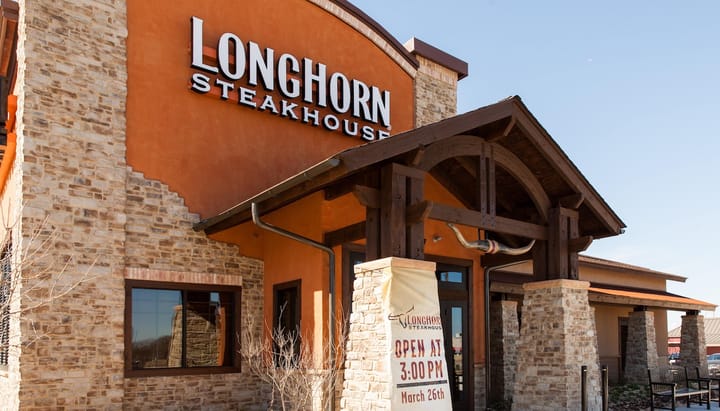
Same-store sales at the steakhouse chain jumped by 9.5% last quarter, thanks in part to demand for lamb.
June 25, 2026
LongHorn Steakhouse is on a tear.
Same-store sales at the 618-unit steak chain surged by 9.5% year over year in the quarter ended May 31, driven by traffic growth of 4.2%. It was LongHorn’s best same-store sales performance since the fourth quarter of 2022 and followed a 7.2% increase in the prior quarter.
LongHorn’s total sales grew nearly 22%, to more than $1 billion in the quarter, a first for the chain.
Executives for parent company Darden Restaurants credited a record Mother’s Day as well as strong demand for lamb chops. That was driven in part by a viral social media post that teased the return of the popular seasonal protein.
“We bought more lamb this year than last year, and we sold out in half the time,” Darden CEO Rick Cardenas said during an earnings call Thursday.
Aside from those seasonal sales boosters, Cardenas said 10 years’ worth of food and service investments at LongHorn are paying off. The chain’s food quality scores are higher than ever, and service continues to improve, he said.
It also helps that beef is still very expensive at the grocery store due to a historic cattle shortage. “The relative value looks a little bit better for LongHorn,” Cardenas said.
LongHorn tends to be overshadowed in Darden's portfolio by its larger sibling, Olive Garden, but it is a giant in its own right. It’s the sixth-largest casual-dining chain in the U.S., with total sales of more than $3.2 billion last year, according to Technomic data. And it’s still growing, opening 27 net new restaurants last quarter alone.
“Longhorn continues to increase market share, with strong and sustained sales growth exceeding the industry,” CFO Raj Vennam said during the earnings call.
As for Olive Garden, it had a solid quarter, with same-store sales growth of 2.4% year over year, including slightly positive traffic. It outpaced the broader casual-dining segment on both counts, as measured by Black Box Intelligence data. Total sales were $1.5 billion.
It has had success with a Lighter Portions menu, which offers downsized Olive Garden staples at lower prices. These items mixed in the low- to mid-single digits in the quarter and were especially popular during weekend lunch.
They did have a 0.8% negative impact on Olive Garden’s average check due to the lower price point. Vennam said he expects that to be the peak of their impact on check going forward, and noted that the chain’s restaurant-level margins still improved in the quarter, to 24.3%, a 0.5% increase year over year.
In Darden’s fine-dining segment, which includes Ruth’s Chris, The Capital Grille, and Eddie V’s, same-store sales rose 1.9% year over year. In “other business” — Yard House, Cheddar’s, and Seasons 52 — same-store sales were up 3.9%. Yard House had an especially strong quarter.
The results do not include Bahama Breeze, which Darden shut down in the quarter with plans to convert 11 locations to other concepts, or Chuy’s, because it was not owned by Darden for 16 months prior to the start of the fiscal year.
Darden executives also sounded an upbeat note on the state of the consumer. Consumers remain cautious but resilient, and are still willing to spend at restaurants, Cardenas said. And in a bit of a change from recent quarters, Darden’s casual brands saw visits increase across all income brackets.
Cardenas said tax returns might have had something to do with that, but declined to confirm whether budget-friendly offerings like Lighter Portions at Olive Garden may have attracted more lower-income customers.
“It's still early to determine exactly what the reasons were, but we feel pretty good about it,” he said.
The quarter was Darden’s fiscal fourth, and same-store results for the full year were as follows:
Consolidated Darden: 4.5%
Olive Garden: 4%
LongHorn Steakhouse: 7.2%
Fine dining: 1.2%
Other business: 3.9%, including 5.6% for Yard House
Consolidated Darden: 4.5%
Olive Garden: 4%
LongHorn Steakhouse: 7.2%
Fine dining: 1.2%
Other business: 3.9%, including 5.6% for Yard House
Total sales were $13.21 billion, a 9.4% increase, driven by the same-store sales growth and the addition of 43 net-new restaurants.
As the Orlando-based company looks ahead to a new fiscal year, it is expecting total sales of $13.6 billion to $13.75 billion; same-store sales growth of 2.5% to 3.5%; and earnings before interest, taxes, depreciation, and amortization (EBITDA) of $2.26 billion to $2.29 billion.
It is also planning 75 to 80 restaurant openings. Combined with the 11 planned Bahama Breeze conversions, that represents a big step-up in development. Last year, Darden had 71 gross openings. “We’re actually going to have roughly 20 more openings year over year,” Vennam said.
That will call for an increase in capital expenditures. The company is forecasting $850 million on that line over the next 12 months, $500 million of which will go toward unit development, with the remaining $350 million earmarked for building maintenance and technology investments.
Darden will also have new restaurants open in Spain, India, and Canada, where multiyear franchise agreements to open dozens of locations are just getting off the ground. Fiscal 2027 is set to be a record year for international openings for Darden, Cardenas said.
Darden’s stock was down just over 1% as of early Thursday afternoon.
About the Author
Joe Guszkowski
Senior editor, Restaurant Business
Joe Guszkowski is a senior editor with Restaurant Business covering technology and casual-dining chains.
Content Spotlight
The Technomic Top 500: Another tough year for chain restaurants
Top 500 chain restaurant sales slowed again in 2025 as consumers cut back on dining, but sectors like coffee, beverages and snacks and chicken thrived
Featured
Jun 25, 2026
Jun 17, 2026
Recent News
Content Spotlight
Get to know Rick Cardenas, the Darden CEO who started there as a busser
The executive shares his advice, along with his most-binged TV show, favorite sports team, and most-used app
Source: This story originated with Nation's Restaurant News.
View Original Article →