
Why dealing with high turnover takes more than fast hiring
Voices from around the restaurant industry
The complexity of the kitchen needs more scrutiny from restaurateurs.
July 1, 2026
High turnover is a never-ending challenge for restaurants. According to restaurant POS provider Toast, restaurants experience an average annual employee turnover rate of 78%, creating a constant need to onboard and train new staff.
To address the challenge, operators have invested heavily in hiring, retention, and training initiatives. While those efforts remain important, there’s another factor that receives less attention: the complexity of the kitchen itself.
When workflows, station layouts, and daily routines are difficult to learn, every new hire faces a steeper learning curve. Simplifying kitchen operations won't eliminate turnover, but it can help employees become productive more quickly, perform more consistently, and complete training with less hands-on support.
For operators navigating persistent turnover, streamlining operations offers an opportunity to reduce training time and improve day-to-day efficiency.
Why kitchen complexity makes turnover harder to manage
Despite high turnover, most restaurants still struggle to train new hires quickly without compromising service. Operators have to get employees up to speed while maintaining the consistency guests expect.
That challenge grows when new hires are left to learn through uneven workflows, unclear station setups, and processes that live mostly in veteran employees’ heads.
During service, experienced employees often spend valuable time answering questions, correcting mistakes, and filling knowledge gaps while trying to manage their own responsibilities. Productivity slows, communication becomes more difficult, and maintaining consistency becomes a struggle during busy shifts.
And the more complexity new employees need to navigate, the longer it takes for them to become confident contributors.
Three ways to simplify training in your kitchen
While you may not be able to control turnover, you can control how easy it is for employees to learn and succeed within your operation.
A few operational adjustments can reduce training friction while helping your team perform more consistently during service.
Don’t rush the onboarding process
Don’t rush the onboarding process
When you're short-staffed, it's tempting to get new hires onto the line as quickly as possible. The problem is that rushing the process rarely delivers the outcome you're hoping for.
New employees need time to learn your systems, understand your expectations, and become comfortable with the pace of service. Throwing someone into a busy shift before they're ready often creates additional pressure for the rest of the team. Experienced employees end up answering questions, correcting mistakes, and covering gaps while trying to manage their own responsibilities.
A mindset I’ve always valued is “train your replacement.” Ideally, every departing employee would have enough time to show the next person how the role works, where to find what they need, and how to avoid common mistakes.
Most operators know that's not always realistic, but the principle still matters. The more opportunities you create for knowledge transfer, the smoother the transition becomes.
Apply mise en place beyond food preparation
Apply mise en place beyond food preparation
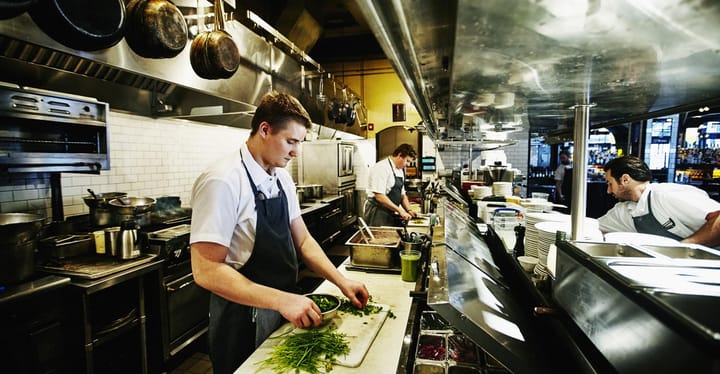
Most chefs think of mise en place as ingredient preparation, but the concept should extend much further. Everything in your kitchen should have a place. Not just ingredients, but tools, equipment, containers, and supplies as well.
When employees know exactly where to find what they need, they spend less time searching and more time executing. If someone doesn't need to think about where the spatula is because it's always in the same place, that's more brain space available for technique, quality, and service.
An expanded approach to mise en place becomes especially important when you're onboarding new team members. Every unnecessary decision adds friction to the learning process. Every moment spent hunting for tools slows work down.
Consistency creates confidence. When stations are organized the same way every day, employees can focus on the work instead of trying to navigate the environment around them.
Design for economy of movement and thought
Design for economy of movement and thought
One of the most valuable exercises you can do is walk through your operation and look for unnecessary movement.
Think about each station individually and ask:
What does that employee need throughout the shift?
Where should those items be located?
Are they taking extra steps to complete routine tasks?
Are they constantly reaching, walking, or searching for something?
What does that employee need throughout the shift?
Where should those items be located?
Are they taking extra steps to complete routine tasks?
Are they constantly reaching, walking, or searching for something?
The goal is to create economies of movement and thought.
If you're selling toast on the first floor, don't put the toaster on the second floor and store the bread in the basement.
It's a simple example, but the principle applies everywhere in the kitchen. Poor layouts force employees to work harder than necessary — especially new hires.
Experienced employees can often work around inefficiencies because they've learned the system over time. New employees don't have that advantage. The easier your operation is to navigate, the easier it becomes to train people and maintain consistency when staffing changes occur.
Build a kitchen that can adapt
No operator wants to spend every few months solving the same training challenges.
The easier your kitchen is to navigate, the easier it becomes for employees to learn, contribute, and perform with confidence. Clear workflows, organized stations, and thoughtful layouts reduce friction for new hires while helping experienced team members stay focused on execution.
You can't control every staffing change that comes your way, but you can control how prepared your operation is to handle it. When everything has a place and every station is designed with purpose, your team can spend less time figuring things out and more time delivering a consistent guest experience.
About the Author
Derek Clayton
Derek Clayton serves as a Corporate Chef at Vitamix. In this role, he is responsible for product testing and recipe development serving various departments including product management, marketing, engineering, and sales teams. Prior to joining Vitamix, Clayton built a diverse culinary career throughout Ohio, most recently serving as the Corporate Chef for the Michael Symon Restaurant Group.
Content Spotlight
The Technomic Top 500: Another tough year for chain restaurants
Top 500 chain restaurant sales slowed again in 2025 as consumers cut back on dining, but sectors like coffee, beverages and snacks and chicken thrived
Featured
Jun 25, 2026
Jun 17, 2026
Recent News
Content Spotlight
Get to know Rick Cardenas, the Darden CEO who started there as a busser
The executive shares his advice, along with his most-binged TV show, favorite sports team, and most-used app
Source: This story originated with Nation's Restaurant News.
View Original Article →